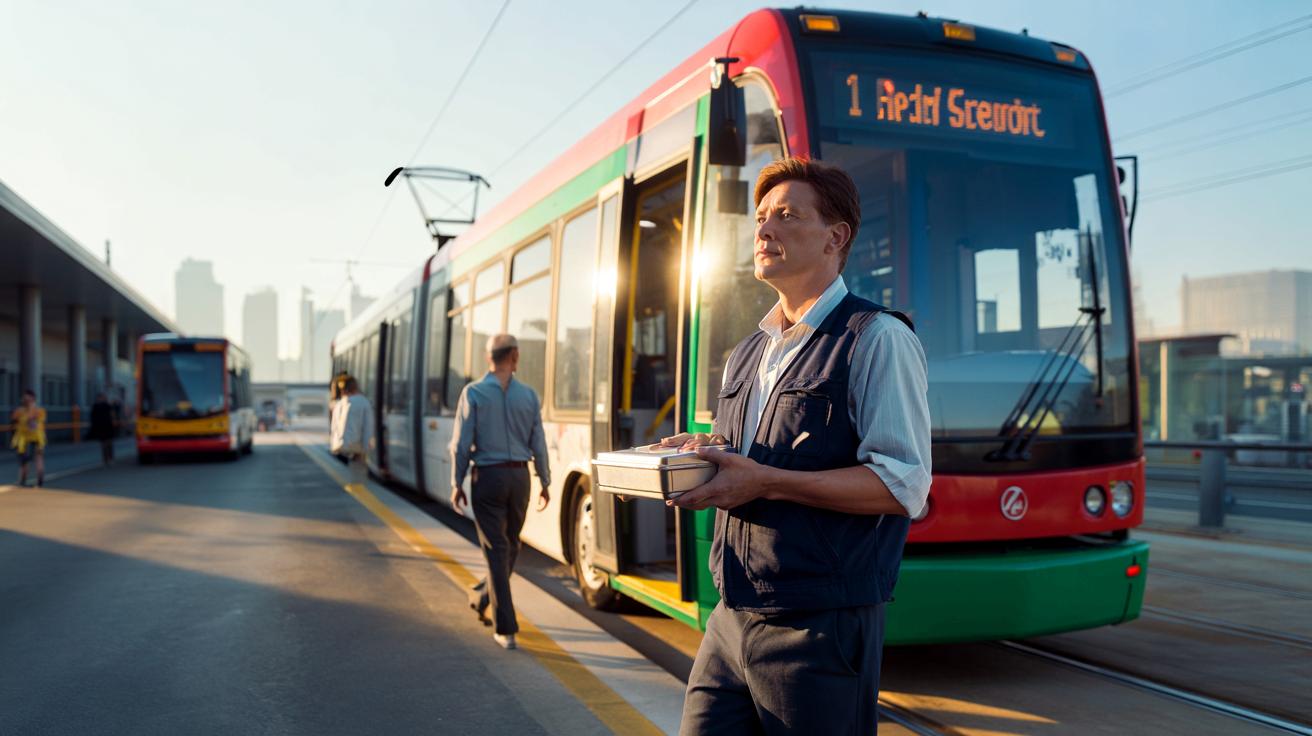
The tram was packed, the usual 8:17 am shuffle of half-awake faces and headphones. A man in a neon vest sat across from me, lunchbox on his knees, hands still a bit dirty from the early shift. While everyone else scrolled through emails or Slack messages, he just stared out the window, eyes calm, as if the day couldn’t surprise him anymore. No goals to hit, no weekly performance review, no trembling before a PowerPoint slide with “Q3 targets” in red.
When he got off at the depot, he moved slowly, almost peacefully. I heard him tell a colleague, “At least at the end of the month, the money’s there. That’s what counts.” The sentence hung in the air longer than the tram’s brakes.
A job where your income doesn’t depend on your performance scoreboard.
It exists.
And it’s closer than you think.
This quiet profession where the paycheck doesn’t depend on your mood
Spend a day near a bus depot or maintenance yard, and you’ll feel it right away. The rhythm there has nothing to do with open-space offices or hyperactive startups. People clock in, do their shift, clock out. The work is physical, sometimes repetitive, sometimes tiring, but the money doesn’t go up and down like a yo-yo depending on someone’s spreadsheet.
Public service drivers and operators – bus drivers, tram drivers, metro operators – live in a parallel universe to commissions and bonuses. Their salary is written in a grid. You move up with seniority and training, not with “over-performance”. You don’t wake up wondering if the boss liked your presentation. You mostly think about traffic, passengers, and getting home in one piece.
Take Sarah, 34, bus driver for a city transit authority. Before this, she was in sales, paid partly on commission. The last year before she quit, she didn’t sleep properly for months. Every Monday started with the same fear: “What if I don’t hit my numbers this quarter?” She dragged her anxiety home, watched her bank account as if it were a live bomb, and learned to judge her own worth in euros and percentages.
When she passed the driving exam and joined the public transport company, the first shock wasn’t the early shifts. It was the payslip. Each month: same amount. No surprise. No bonus, true, but also no punishment. She told me: “I’m not rich, but I can breathe. I know what’s coming in. It changes the way you sleep.”
This kind of job runs on a different contract with reality. You commit to a schedule, safety rules, and service to the public. In return, you get income that doesn’t play hide-and-seek with you. There are evaluations, yes, and rules can be strict, but your basic salary is not tied to how “impressive” you look in a meeting. You’re no longer a number on a dashboard, you’re a link in a system that must run, every single day.
*That’s the hidden luxury of these professions: your value isn’t a monthly debate.*
How to enter a secure-income profession without burning out
The path into this kind of job often looks more accessible than people think. For public transport roles, you usually start with a basic requirement: clean driving record, medical fitness, maybe a high school diploma. The heavy-lifting begins with the selection tests and training. Think driving tests, psychotechnical exams, situational judgment tests. They’re not made to scare you but to check your reflexes, your patience, your ability to stay calm when everything around you gets loud.
➡️ This is why your home feels cluttered even after tidying
➡️ If you feel unsettled when there’s nothing to fix, psychology explains the discomfort
➡️ If you feel tension when things go smoothly, psychology explains the internal expectation
➡️ This habit quietly drains clarity during routine moments
➡️ “I thought my budget failed because of emergencies, it was something else”
➡️ I tried this baked pasta using penne, tomato sauce, and a light cheese topping
➡️ Psychology shows why emotional engagement can feel draining even without conflict
➡️ “I became a safety coordinator, and the responsibility comes with real financial rewards”
The training is paid in most public operators. You learn routes, safety procedures, how to talk to passengers when they’re stressed, drunk, tired, or just lost. You also learn the timetable culture: you start on time, you end on time, and between those two points, your responsibilities are clear. Your financial future looks less like a gamble and more like a rail track.
A lot of people hesitate because they’re afraid of being “stuck at the wheel”. They imagine endless loops around the city, same streets, same jokes, same arguments. Some even feel guilty for wanting stability instead of chasing “success”. We’ve been sold the idea that a good career means endless ambition and constant self-optimization. If you’re not always reaching for the next level, are you failing?
Here’s the plain-truth sentence: nobody really wants to live on a performance roller coaster forever.
There’s nothing weak about choosing a job where the end of the month is predictable. The real trap is thinking that peace of mind is a lack of courage. The mistake many people make is waiting for burnout or a layoff before they allow themselves to look for a calmer, more secure track.
“People say my job is boring,” a tram driver told me, pulling his thermos from his bag. “I say boring is refreshing when you’ve spent years checking your phone every ten minutes to see if a client signed or not.”
- Learn about local public operators: City or regional transport authorities, national rail companies, airport shuttles, school bus operators. Their websites often list recruitment campaigns.
- Check the salary grids: They’re usually public. You can see how your income grows with years of service, nights, weekends, or specific responsibilities.
- Talk to people already in the job: Ask them about schedules, fatigue, family life, and real take-home pay. The unfiltered version is worth gold.
- Get comfortable with irregular hours: Nights, weekends, early mornings are often part of the deal. The payoff is that your pay does not flirt with you then disappear.
- Accept the trade-off: You probably won’t get explosive raises, but you also won’t wake up one day to a sudden 40% drop because “the numbers weren’t good enough”.
Choosing stability in a world obsessed with performance
We’ve all been there, that moment when a manager drops yet another “stretch goal” into a meeting, and you feel your shoulders tense before the coffee even cools. Jobs where your salary depends on performance play on a very fragile part of us: the fear of not being enough. After a few years, your nervous system forgets what “normal” feels like. You scan your boss’s expression the way a driver scans a rear-view mirror before changing lanes.
Professions like public transport, postal services, hospital support staff, municipal maintenance teams, offer a different narrative. Your contribution is measured in continuity, not in fireworks. You don’t “smash targets”, you keep things running. You’re not chasing a monthly applause, you’re part of a structure that quietly holds society together. There’s less glamour, fewer LinkedIn trophies, more evenings where your heart rate doesn’t spike when you open your banking app.
If your life right now feels like a permanent sales pitch, this kind of job can act like a reset button. It won’t solve everything. Money may still be tight, shifts can be heavy, passengers can be rude. Yet something fundamental changes when your worth is not re-negotiated every quarter. You can plan. You can breathe. You can be average on a Tuesday and still pay rent at the end of the month.
Maybe that’s the real revolution: a profession where your payslip doesn’t depend on how impressive you look, but on the fact that you simply show up, day after day, and do the work.
| Key point | Detail | Value for the reader |
|---|---|---|
| Predictable salary | Public transport and similar roles use fixed salary grids, not variable commissions | Less financial anxiety and easier long-term planning |
| Accessible career path | Recruitment often based on driving record, basic education, and paid training | Realistic reconversion option for people tired of performance pressure |
| Clear trade-offs | Stable income in exchange for shifts, rules, and limited bonuses | Helps decide if this compromise matches your needs and values |
FAQ:
- Question 1Which profession are we really talking about when we say “income security without performance pressure”?
- Answer 1Mainly public transport operators: bus drivers, tram and metro drivers, sometimes train conductors, as well as other public service roles where salary is based on grids, not on individual sales or variable targets.
- Question 2Do these jobs really have zero performance evaluation?
- Answer 2No, there are rules, safety checks, and sometimes evaluations, but your base salary doesn’t usually depend on monthly “results”. As long as you respect procedures and show up, your income stays stable.
- Question 3Can you earn a decent living as a bus or tram driver?
- Answer 3Yes, especially with seniority, nights, weekends, and public holidays. The salary won’t be spectacular at the beginning, but the regularity and benefits (pension, health coverage, job security) change the overall picture.
- Question 4Is it realistic to switch to this career after 30 or 40?
- Answer 4Yes, many operators actively recruit career changers. If you’re medically fit and motivated, your age can even be seen as a sign of stability and seriousness.
- Question 5What’s the biggest downside of these secure-income professions?
- Answer 5The main challenges are irregular hours, fatigue from long shifts, and contact with sometimes difficult users. The key is to weigh those constraints against the peace of mind of a stable paycheck that doesn’t depend on hitting targets.