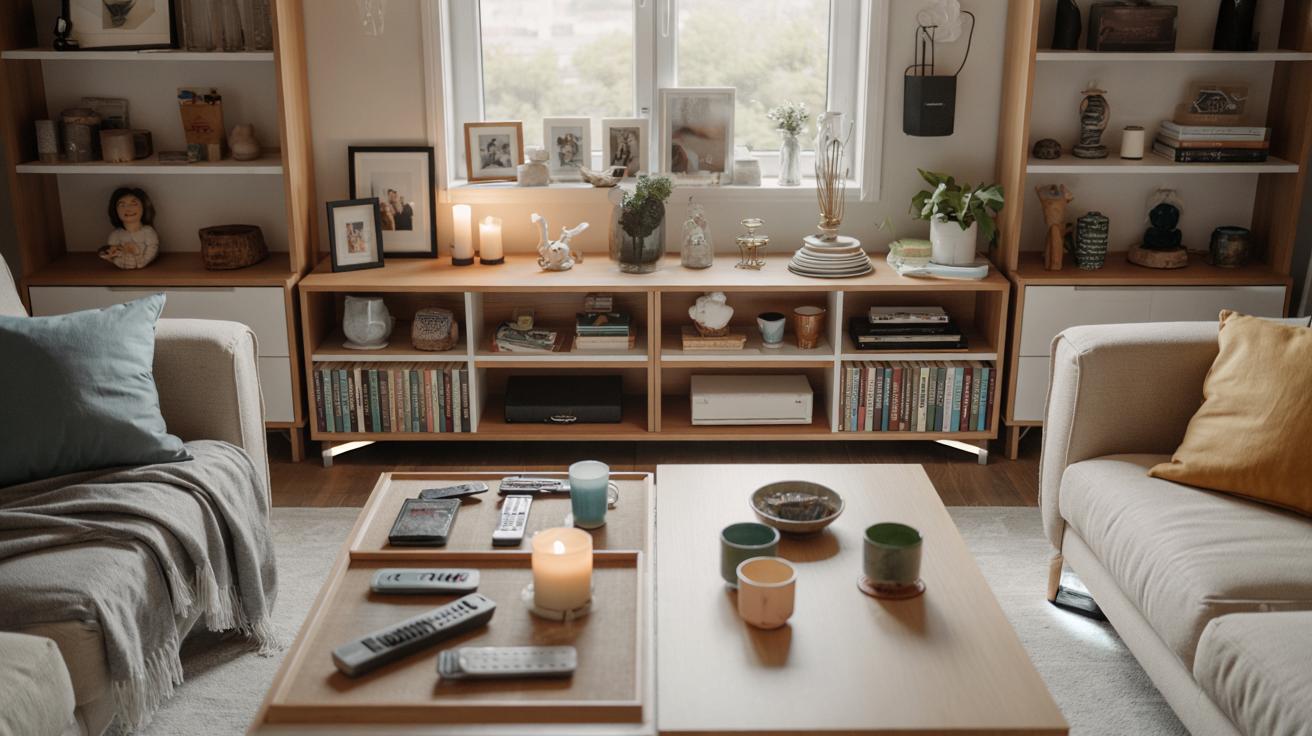
You close the closet door with your hip, shove a stray sock under the bed, fluff the cushions. The flat looks… presentable. Candles lit, surfaces wiped, throw blanket folded just so. For a few minutes you even feel proud. Then it hits you again, like a low hum in the background: your home still feels busy, heavy, a little suffocating.
Nothing’s technically messy, yet your eyes don’t know where to rest. Your brain keeps scanning corners: that “miscellaneous” basket, the too-full bookshelf, the chair that’s really just a laundry stand in disguise.
You did the work. You tidied. So why does the space still feel crowded, like you can’t quite exhale?
There’s a hidden kind of clutter we rarely talk about.
When “tidy” is still visually noisy
Walk into a hotel room and notice how fast your shoulders drop. Bare surfaces. Two or three objects per zone. Neutral colors that don’t shout over each other. Then think about your living room: the candles, coasters, remotes, chargers, throw pillows, decorative tray, three mugs, and that plant that’s half alive, half apology.
The room might be technically clean, but every object is sending a signal to your brain. Your eyes jump from thing to thing like tabs on a browser. That’s why you feel tense, even when nothing’s obviously out of place.
You’re not imagining it. Your space really is talking too loudly.
One woman I interviewed swore her home “just never felt calm” no matter how often she tidied. She vacuumed, wiped, and folded constantly, yet still felt on edge in her own living room.
We walked around together, and counted. She had 27 items on her TV stand alone. Little things she genuinely liked: framed photos, candles, a diffuser, souvenirs, a plant mister, stacked books, a tiny sculpture, random cables. Nothing was dirty. Nothing was technically wrong.
But lined up together, all those “small” things created a constant buzz. Her home wasn’t messy. It was visually overloaded.
➡️ This profession offers income security without performance-based pressure
➡️ “I overthink everything after it happens”: psychology reveals why your mind keeps replaying moments
➡️ This profession provides income growth through specialization, not job hopping
➡️ This is why some days feel heavier than others, even without stress
➡️ If you struggle to say no without guilt, psychology explains what your mind is afraid of losing
➡️ I tried this baked pasta using penne, tomato sauce, and a light cheese topping
➡️ “I thought my budget failed because of emergencies, it was something else”
➡️ “I became a safety coordinator, and the responsibility comes with real financial rewards”
Here’s what’s going on in the background: your brain can only process a certain amount of visual information before it feels tired. Every object you see adds micro-work. A bright logo on a box. A different color on each book spine. A pile that’s “organized” but still visible.
So you tidy by moving things into neat clusters. You line them up, stack them, group them. That feels productive. Yet the visual volume stays just as high. *You’re rearranging clutter, not reducing it.*
That’s the quiet reason your place still feels crowded, even on its best days.
The clutter that hides behind “just in case”
Try this small shift the next time you “clean up”: instead of asking “Where does this go?”, ask “Do I still want this in my life at all?” It sounds dramatic, but it changes everything. You go from shuffling belongings around to actually editing what’s allowed to stay.
Pick a single surface: the bedside table, kitchen counter, or entryway console. Hold every item and ask a blunt question: “Did I use or enjoy this in the last 30 days?” If not, it goes into a temporary box, out of sight. Not the bin yet. Just out.
Live one week without that box. If you don’t go looking for what’s inside, there’s your answer.
A lot of hidden clutter is disguised as “responsible adulthood.” Backups, extras, spares, just-in-case purchases from sales that looked too good to pass up. Three sets of measuring cups, five hand creams you half-like, a drawer of tangled cables “for later.”
One reader told me she had four identical black cardigans, all slightly different. She wore the same one on repeat, but felt oddly guilty letting go of the others. They’d cost money. They were still “good.” So they lived in her wardrobe, eating space and whispering small, nagging thoughts every morning.
The emotional weight wasn’t in the fabric. It was in the story she’d attached.
This is where the logic kicks in. Most of us don’t lack space. We lack boundaries. We say yes to every new object, but we never say goodbye. Shelves are finite, but our “might need this one day” list feels infinite.
Let’s be honest: nobody really does this every single day. We don’t declutter in real time. We let things accumulate in silent layers: kids’ artwork, old chargers, sentimental kitchenware from three apartments ago. Then one day we suddenly wonder why breathing feels harder at home.
Your home isn’t betraying you. You’re just living with yesterday’s decisions on every shelf.
How to make space without living in a showroom
Forget color-coding your pantry for social media. Start with something smaller and far more realistic: the “one calm corner” rule. Pick one spot in your home that will stay nearly empty on purpose — a side table, the coffee table, a bedroom dresser.
On that surface, allow a strict maximum of three objects. Maybe a lamp, a book you’re actually reading, and one decorative item. Nothing else. Not mail. Not keys. Not yesterday’s glass. That corner becomes your visual rest area.
Once you feel the difference in that one calm corner, you’ll want to spread that feeling, slowly, to the rest of the room.
The biggest mistake people make is decluttering like they’re on a game show: all in one frantic weekend, then crashing back into old habits. That leads straight to rebound clutter and a heavy dose of shame. You don’t need a dramatic purge. You need gentle, consistent editing.
Try micro-rounds: five minutes before bed, you choose five things to remove from a single room. Trash, donate, relocate — doesn’t matter. Just five. Low drama, low decision fatigue.
Be kind to the sentimental stuff. If you’re not ready, don’t force it. Start with the cheap, replaceable, neutral things you won’t remember in a month.
“Clutter isn’t just what’s on your floor. It’s anything that stands between you and the life you want to live at home.”
- Choose one “calm corner” with only 2–3 visible objects.
- Use a temporary “out-of-sight” box to test what you truly miss.
- Practice five-minute, five-item decluttering sessions.
- Edit duplicates: keep your favorite, release the rest.
- Store categories together so you see what you already own.
When your home finally matches your real life
Once you start seeing clutter as “visual noise” instead of “moral failure,” something loosens. Tidying stops being this endless, slightly humiliating chore, and becomes a quiet conversation with yourself: Does this still fit my days? Does this version of me still need this?
Your home turns into a mirror of who you are now, not a museum of past hobbies, old jobs, unfinished projects, and impulse buys. The kitchen only holds tools you actually cook with. The bathroom cabinet no longer hides a graveyard of half-used products. The living room has spots where your eyes can rest without bumping into a logo or a pile.
You start to notice that you sleep better. You find things faster. You sit on the sofa and don’t immediately feel the urge to get up and “fix” something.
A tidy home is one thing. A home that feels light is something else entirely.
| Key point | Detail | Value for the reader |
|---|---|---|
| Visual noise matters | Too many visible objects exhaust the brain even when spaces are “clean” | Helps explain why home feels crowded despite regular tidying |
| Edit, don’t just organize | Ask what deserves to stay, not just where things should go | Reduces long-term clutter instead of shuffling it around |
| Small habits beat big overhauls | Calm corner rule, five-item sessions, temporary boxes | Makes change realistic, sustainable, and less overwhelming |
FAQ:
- Why does my home feel cluttered even when everything is put away?Because “put away” often means grouped and visible. Your brain still sees dozens of items and reads them as work, noise, and decisions waiting to be made.
- How do I start if I’m completely overwhelmed?Choose the smallest surface in the room you use most. Clear it, then put back only three things you love or use daily. Stop there for today.
- What about sentimental items and gifts?Store them in a dedicated box or shelf instead of scattering them everywhere. You’re allowed to keep memories without letting them occupy every surface.
- Do I need to get rid of a lot of stuff to feel a difference?Not always. Hiding visual clutter in closed storage, grouping similar items, and limiting what lives on surfaces can already transform how a room feels.
- How can I keep clutter from coming back?Adopt one entry rule: for every new item that enters your home, one old item leaves. It’s a simple brake on the slow, constant drift toward “too much.”