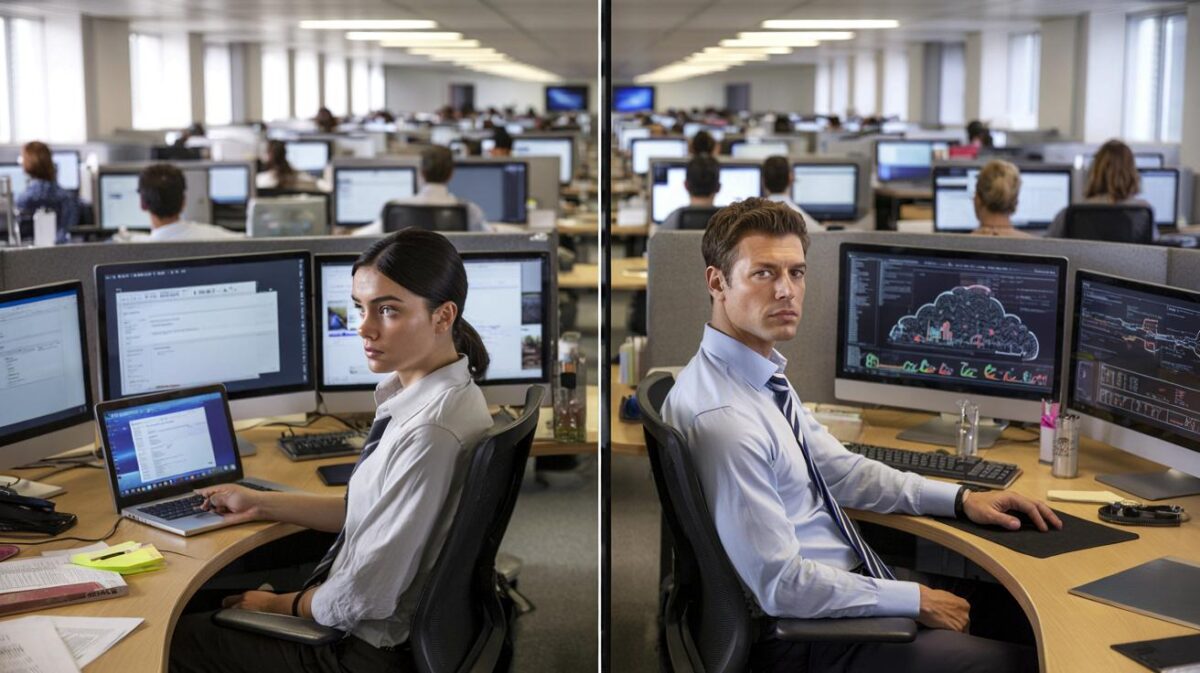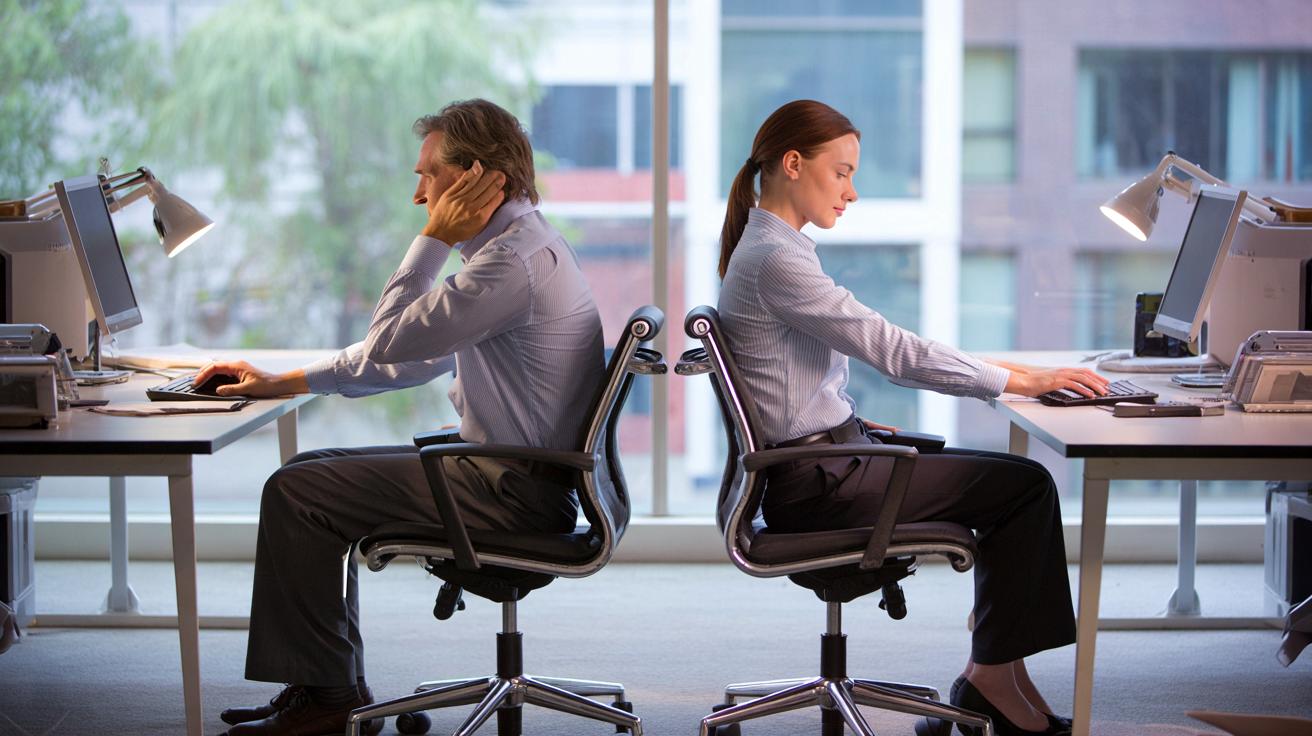
The office was so quiet you could hear the air conditioning thinking. Screens glowed, fingers clicked, and every few minutes someone shifted in their chair with that tiny, defeated sigh. You know the one. The “my back hurts but I still have four hours of work” sigh. A colleague next to me kept rolling his shoulders, stretching his neck, then sinking back into the same collapsed posture that had caused the pain in the first place. Ten minutes later, same sigh, same shuffle, same wince.
We don’t notice how we sit until our body starts to complain.
Then it starts whispering something else.
Most people sit like they’re folding in on themselves
Watch people sitting on a train or in an open-plan office. Hunched shoulders, necks reaching forward, pelvis tucked under like they’re bracing for a punch. It looks like everyone is slowly melting into their chairs. You can almost see the energy draining out of them.
The irony is we call it “relaxing” when we finally slump into that position.
Yet our muscles read it like a long, uncomfortable apology.
I once observed a meeting where nobody moved for a full hour. Eight people around a table, all slowly sagging lower, eyes dimming. By the halfway mark, three were rubbing their lower back, one was stretching his wrist under the table, another had started massaging her jaw.
The content of the meeting hadn’t changed. The posture had.
Their bodies looked like a live demonstration of “how to generate fatigue while doing absolutely nothing.”
There’s a simple reason this sitting style exhausts us. When you slump, your pelvis tilts backward, your spine curves into a C-shape, your head slides forward. That tiny shift makes your neck muscles work overtime to hold your heavy skull, your back muscles strain to keep you upright, and your breathing becomes shallow. Less oxygen, more muscle tension, constant micro-effort.
You feel tired and foggy, so you move even less.
It’s a sneaky loop: posture quietly drains your battery, then blames “a long day” for the crash.
The tiny adjustment that changes everything
Here’s the adjustment that breaks that loop: start sitting from your pelvis, not your shoulders. Instead of “sit up straight”, think “tip your pelvis slightly forward until your sit bones point down”. Those bony points under your butt? They’re your built-in tripod.
Plant them evenly on the chair and let your spine stack itself on top.
Your chest opens on its own, your head floats above your shoulders instead of hanging in front of them.
The first time I tried this, I felt ridiculous. I sat on the edge of my chair, found my sit bones, tilted my pelvis a tiny bit forward, and suddenly my back… stopped yelling. My shoulders dropped. My breathing deepened without effort.
Five minutes later I forgot about it, slumped again, and the old fatigue crept back.
Let’s be honest: nobody really does this every single day without some reminders. The trick is not perfection, but catching yourself once or twice an hour and gently resetting from the pelvis, not by puffing your chest like a soldier.
One plain truth: most of us try to “fix” our sitting by yanking our shoulders back. That usually lasts thirty seconds, hurts, and then we sink lower than before. The body hates forced stiffness. What it accepts is small, repeatable, almost lazy corrections.
Think: feet flat on the floor, sit bones grounded, pelvis slightly forward, spine like a tall, soft rope. Your lower ribs floating above your hips, not collapsing into them.
*Good sitting doesn’t feel heroic. It feels quietly stable.*
- Feet: flat on the ground, hip-width apart, not wrapped around chair legs
- Pelvis: tilt slightly forward until you feel weight on your sit bones, not your tailbone
- Back: tall but relaxed, not forced, think “length” instead of “straight”
- Screen: roughly at eye level, so your chin doesn’t drift toward your chest
- Breaks: 30–60 seconds of standing or walking every 30–45 minutes
A different way of sitting in your own life
Once you start noticing how you sit, you realize it’s not just about ergonomics. It’s a kind of quiet relationship with yourself. How do you take up space at your desk, on the couch, in a meeting where you feel judged, in a train when you’re exhausted?
Sitting from your pelvis, with your spine supported instead of collapsed, doesn’t just reduce fatigue. It subtly shifts how awake you feel in your own life.
You may catch yourself breathing a little deeper during a tough email, feeling less drained after a Zoom call, or simply arriving home tired but not wiped out.
We’ve all been there, that moment when you stand up from your chair and your body feels ten years older than your actual age. Imagine that same moment, but with a different baseline: joints less stiff, back not screaming, head less foggy. The day was still long, the work still demanding, the commute still annoying.
Only your posture didn’t sabotage your energy on top of everything else.
That’s the quiet power of this tiny adjustment: you do exactly what you were going to do anyway… just sitting in a way that doesn’t slowly drain your battery.
➡️ This tiny habit makes everyday choices feel heavier
➡️ If you feel unsettled when there’s nothing to fix, psychology explains the discomfort
➡️ I tried this baked pasta using penne, tomato sauce, and a light cheese topping
➡️ This profession offers income security without performance-based pressure
➡️ This is why your home feels cluttered even after tidying
➡️ If you feel tension when things go smoothly, psychology explains the internal expectation
➡️ If you struggle to say no without guilt, psychology explains what your mind is afraid of losing
➡️ This is why some days feel heavier than others, even without stress
| Key point | Detail | Value for the reader |
|---|---|---|
| Sit from the pelvis | Use your sit bones as the base, with a slight forward tilt | Less muscle tension, more natural support |
| Small, frequent resets | Correct posture once or twice an hour, not perfectly all day | Realistic habit that sticks over time |
| Align screen and feet | Feet flat, screen near eye level, avoid neck craning | Reduces fatigue in neck, eyes, and shoulders |
FAQ:
- Question 1How do I find my sit bones when I’m on a soft chair?
- Answer 1Slide a little closer to the front edge, rock gently forward and back, and feel for two firm points under each side of your butt. That’s them. Once you’ve found them, keep your weight there rather than on your lower back.
- Question 2Is crossing my legs really that bad?
- Answer 2Occasional leg crossing is fine, but staying that way for hours shifts your pelvis and spine off-center. Alternate positions, and regularly come back to feet flat, hip-width apart as your “home base”.
- Question 3Do I need an expensive ergonomic chair?
- Answer 3An ergonomic chair can help, but the real game-changer is how you use your pelvis, feet, and screen height. Many people feel better after adjusting their posture on a basic chair than slumping in a pricey one.
- Question 4How often should I stand up during the day?
- Answer 4A simple rhythm is 30–60 seconds of standing, stretching, or walking every 30–45 minutes of sitting. Even tiny breaks reset your muscles and your focus.
- Question 5What if my job keeps me stuck at a desk?
- Answer 5Then these micro-adjustments matter even more. Sit from your pelvis, align your screen, keep your feet grounded, and build in brief movement breaks. You don’t need more hours in the day, just kinder minutes for your body.